
Go farther and stay out longer with the TOPO DC POWER.
Topo’s Modern dual battery systems are designed to be installed outside the engine compartment or “under the bonnet” for improved safety, performance, and reliability. They can be installed in a variety of locations, such as the rear cargo area, or in a battery box or tray mounted to the chassis or body.
A true Plug & Play system, Topo’s Modern portable dual battery systems halve dual battery installation and wiring costs, are longer lasting and offer benefits such as:
Our battery system models
The 72Ah Centerfire is the most complete and portable dual battery system in the market. Weighing in at 10.5KG and with the footprint of a lunchbox, it boasts over 65 usable amps( 780WH). The ultimate primary or backup battery system to take with, in any car, caravan and gathering.
Ideal for:
The 144Ah Long Range is a slimline design similar to the size of a briefcase weighing in at 21KG. Offering twice the stored battery capacity of the Centrefire, it can power two times the number of accessories at two times the rated current discharge compared to the Centerfire. This is a product for those looking to take their travelling experience to the next level. Its slim design makes it an ideal fit behind seats and in canopies to gain valuable storage space.
Ideal for:
Portable , Weather-Proof , Water-Proof , Easy Plug-and-Play Setup
The Tinny Mate is Australia’s leading portable auxiliary 12V battery, engineered for durability, reliability, and ease of use. Whether you’re heading off-grid, camping, or need backup power, the Tinny Mate 12V/100Ah capacity and built-in LiFePO4 prismatic cells delivers long-lasting, consistent energy.
Don’t let its compact design fool you. At only 10 kg, the Tinny Mate is power without limits. Its plug-and-play simplicity and built-in battery monitoring mean no complicated setups. Designed and manufactured in Australia, its rugged, waterproof design ensures durability in all weather conditions.
Never Run Out of Power – Stay Charged, Anywhere, Anytime with Tinny Mate
Ideal for:
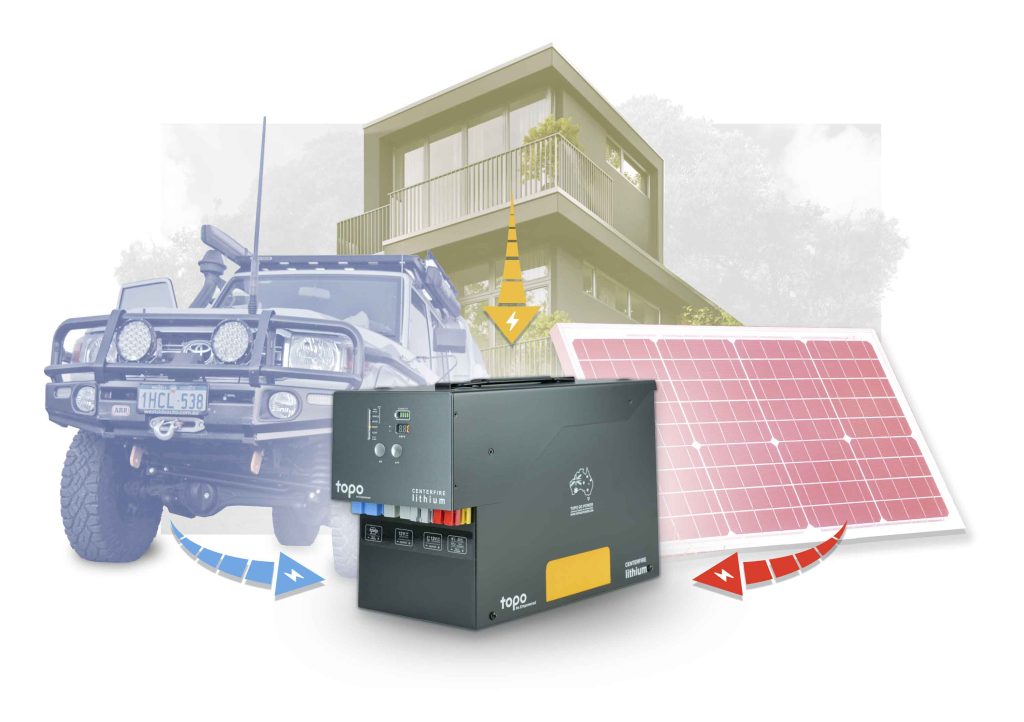
– 20A DC/DC
– 40A DC/DC
– 10A Mains charger
– 20A Mains Charger
Accepts 12V & 24V Solar Panels
VOC : 20-50V | Max: 25A
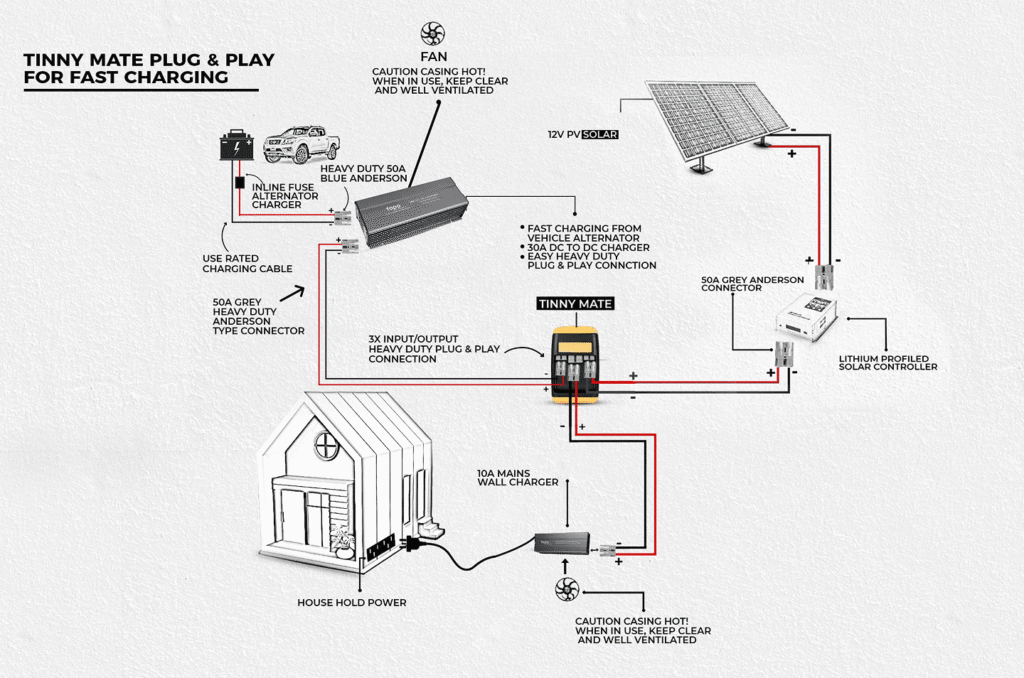
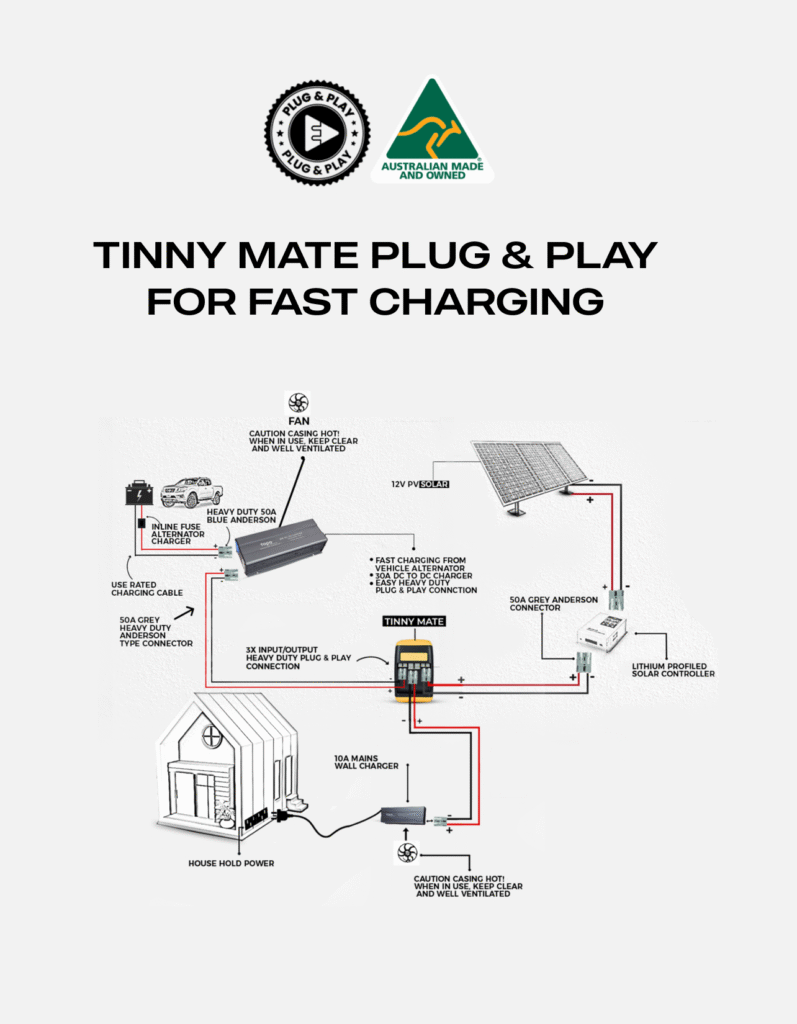
Flexibility of being charged “FAST” from all available Vehicle, Solar & Mains charging sources SIMULTANEOUSLY
0-100% in 1 hour !
Topo Systems can accept a max charge rate of 65Amp, out of the box
– Vehicle 40A DC/DC + Solar & Mains ( Combined 25A )
Our lithium systems range from 12V 72Ah, 12V 144Ah and 12V 216Ah battery capacity, able to provide power when and where you need it most – whether you’re off the grid, on the go or on the trail, you can keep your fridge running, lights on and charge your phone, tablets, and countless other devices.
The Topo Centerfire, is our most portable 12V power system. Comes with a powerful 12V/72Ah (864Wh) LiFePO4 battery that weighs in at around 10kg and equipped with fast charging and features standard across all Topo lithium battery systems.

75+ Charges (72Ah)
170+ Charges (144Ah)
230+ Charges (216Ah)

26-65 Hours (72Ah)
52-130 Hours (144Ah)
78-195 Hours (216Ah)

10+ Charges (72Ah)
20+ Charges (144Ah)
30+ Charges (216Ah)

10+ Charges (72Ah)
20+ Charges (144Ah)
30+ Charges (216Ah)

35+ Charges (72Ah)
75+ Charges (144Ah)
110+ Charges (216Ah)

10+ Charges (72Ah)
20+ Charges (144Ah)
30+ Charges (216Ah)

150+ Charges (72Ah)
300+ Charges (144Ah)
450+ Charges (216Ah)

70-150+ Hours (72Ah)
150-300+ Hours (144Ah)
230-450+ Hours (216Ah)
72Ah = 864 Wh
144Ah = 1728 Wh
216Ah = 2592Wh
When it comes to lithium batteries, safety is a major concern due to the potential for overheating, fire, and explosion. The safest lithium battery cells are those that are designed with built-in safety features to prevent these hazards.
Topo lithium systems use a high quality, A-Grade, Lithium Iron Phosphate (LiFePO4) prismatic cells. Widely used in electric vehicles, mining equipment, rail transportation, renewable energy storage and telecommunications sector. They are considered as one of the safest lithium-ion batteries among other lithium-ion batteries.
Lithium Iron Phosphate (LiFePO4) prismatic cells are a type of lithium-ion battery that use a lithium iron phosphate cathode and a carbon anode. They are known for their high energy density, long cycle life, and high thermal stability, making them a popular choice for a wide range of applications, including electric vehicles, renewable energy storage systems, and portable electronic devices.
Prismatic cells are so called because they are made in a rectangular shape, which is different than having many small cylindrical shape cells.
Some of the key features and benefits of LiFePO4 prismatic cells include:
It’s important to note that even with the safest lithium battery cells, proper usage and maintenance are crucial to ensure safety. It is recommended to use lithium batteries with built-in protection circuit module (PCM) or battery management system (BMS) to ensure the safe operation and prolong the life of the battery.
A “traditional” dual battery system is a system that uses two batteries under the vehicles bonnet instead of just one. These batteries are typically connected in parallel, meaning that the positive terminals are connected together and the negative terminals are connected together. This allows for the two batteries to work together to power the vehicle’s electrical systems, providing increased power and redundancy.
There are a few reasons why a dual battery system might be used in a vehicle:
A Modern dual battery system are increasingly being installed outside of the engine compartment or “under the bonnet” for improved safety, performance, and reliability. These systems may be installed in a variety of locations, such as the rear cargo area, underneath the vehicle, or in a specialized battery box or tray mounted to the chassis or body. The benefit of moving the dual battery system outside of the engine compartment is that it allows for better heat dissipation, which can help extend the life of the batteries and improve overall system performance. Improved accessibility, and reduced risk from other hazards. Modern dual battery systems using lithium batteries are lighter, more compact than traditional lead -acid batteries. Additionally, allowing for more flexible installation options, frees up valuable engine compartment space for other components and makes maintenance and troubleshooting easier.
It is important to note that installing a dual battery system requires knowledge of electrical systems, wiring and termination. Consultation with a qualified automotive technician is recommended.
A DC/DC charger, also known as a DC-to-DC converter or simply a DC charger, is a device that converts one DC voltage level to another. It is used to regulate and fully charge a secondary battery system from a primary battery system in applications such as automotive, marine, and RV systems.
In a DC/DC charger, the input voltage from the primary battery system is stepped down or up to a different voltage level that is appropriate for charging the secondary battery system. This is achieved using electronic components such as inductors, capacitors, and semiconductors that are configured in a specific circuit topology.
DC/DC chargers can provide several benefits over traditional AC chargers in certain applications, including improved efficiency, faster charging times, and greater flexibility in terms of input and output voltage ranges. They are commonly used in off-grid and mobile applications where access to AC power may be limited or non-existent.
Topo’s Built-in DC/DC chargers are compatible with the primary battery charging system used in all make and vehicles including smart alternators and are designed and profiled to suit the lithium batteries used in Topo’s battery systems.
For all special requests and requirements , please contact us here.
When it comes to maximizing the performance and output of your Topo lithium battery system, a larger DC/DC charger is the way to go. In fact, in this case, bigger is definitely better. Upgrading from a 20A DC/DC charger to a 40A DC/DC charger will cut your charging time in half. This is especially important when your battery is flat and you need to keep remote or portable 12V accessories like a fridge or freezer powered.
It’s worth noting that not all vehicle charging systems are designed to handle additional loads beyond what’s specified by the manufacturer. In fact, a vehicle’s alternator is primarily responsible for generating electrical power and charging the starter battery while the engine is running. The alternator powers various electrical components in the vehicle, including the headlights, taillights, interior lights, audio system, and other electronic devices. It also provides power to the vehicle’s ignition system, fuel injection system, and other engine control modules.
So, if you’re looking to upgrade your vehicle’s electrical system or your vehicles is already capable and you want to get the most out of your Topo lithium battery, investing in a larger DC/DC charger is a smart move. It will help you maximize your battery’s potential and keep all of your remote and portable accessories powered up and ready to go, without draining your battery unnecessarily.
Key takeaways to consider:
No, Topo’s Red solar input has a built-in solar regulator, also known as a solar charge controller, is a device that regulates the flow of Direct Current from a solar panel to a battery. It is designed to prevent overcharging and over-discharging of the battery, which can damage the battery and shorten its lifespan.
A solar charge controller regulates the current and voltage coming from the solar panel and ensures that the battery is only charged within its safe operating range. It also prevents reverse current flow, which can occur at night when there is no sunlight, and can drain the battery.
Topo’s Built-in solar regulators are built-in to all our lithium systems and are rated to match 12V and 24V solar panels ( open circuit voltage of 20-50V) and Max charge input of 25Amps. If using your own additional solar controller in series please consider that Topo’s Red Solar Input is ” passive” by design and will only accept an “active” solar charge supply.
It is important to note that the solar panel, battery and load should be matched with the solar regulator capacity and specifications.
The amount of time that a battery will run a 12V fridge depends on a number of factors, including the capacity of the battery, power consumption of the fridge, duty cycle, ambient temperature and the temperature of the fridge’s contents.
A general rule of thumb, based on the assumption that the fridge is running cool, battery is in good condition and fully charged before use. The Topo 72Ah Centerfire will have a capacity of 65 usable Amps this will power an efficient 40L, 12V fridge for 2-3 days in 30°C days set at 3 degrees standalone without charge and expect the Topo’s 144Ah Long Range lithium to power the fridge for twice as long.
However, actual battery runtime will depend on several factors such as:
It is important to use a battery monitor to check the battery capacity and to familiarise yourself with your setup to avoid over-discharging and flattening battery.
It is also recommended to have a plan B in case of battery going flat, such as generator or another charged battery source available.
Automotive cable size and rating refer to the specifications of the electrical cables used in vehicles. The size of the cable refers to its cross-sectional area, typically measured in square millimeters (mm²) or American Wire Gauge (AWG) and or Brown and Sharp Wire Gauge (B&S). The rating refers to the maximum amount of current the cable can safely carry, measured in amperes (A).
When choosing cable size and rating for an automotive application, it’s important to consider the current draw of the device or system being powered and the length of the cable run. A larger cable size will be able to carry more current, and a higher rating will be able to handle more current without overheating.
Here is an example of a chart that shows the recommended cable size and rating for common automotive applications:
| Application | Recommended Cable Size (mm²) | Recommended Cable Rating (A) |
| Headlights | 2.5 | 20 |
| Tail lights | 2.5 | 20 |
| Horn | 2.5 | 20 |
| Starter motor | 35 | 150 |
| Alternator | 35 | 150 |
| Battery to starter motor | 35 | 150 |
| Battery to alternator | 35 | 150 |
| Grounding | 6 | 40 |
| Application. | Recommended Cable Size (mm²) | Recommended Cable Length (M) |
| Topo Lithium Systems 20A DC/DC | 8 | 5-6 |
| Topo Lithium systems 40A DC/DC | 14 | 5-6 |
It’s important to note that this is just an example, and actual cable size and rating may vary based on the specific application and the manufacturer’s recommendations. It’s always best to consult the vehicle’s wiring diagram or the manufacturer’s instructions when working on an automotive electrical system.
It’s also important to use appropriate fuse holders and fuses, cable connectors and terminals with the right size and rating to ensure the cable runs are safe and efficient.
Generally speaking, automotive electrical systems typically use cables that are rated for 12V and have a capacity of 10 amps for basic auxiliary outputs, and up to 50-60 amps for more advanced systems. The size of the cable will vary depending on the amperage rating and the length of the cable run.
It’s also important to note that using the wrong size or rating of cable and poor connections can lead to electrical issues, such as overheating or insufficient power, and potentially cause burn damage to the vehicle’s electrical system.
Hello and welcome to TOPO DC Power!
Feel free to browse and find useful information about our range of Low Voltage DC Powered products and accessories.
The lithium battery specifications, quality and chemistry used in Topo lithium battery systems are rated and allows for seriously “FAST” Charging.
Topo lithium systems are spec’ed to our system and requirements based on our end users needs and applications while offering high quality components and matched to suit existing vehicle charging systems.
In a real case scenario: Topo’s Built in 40A DC/DC Charger is sufficient for most and will maximise the end users battery storage potential.
Dependent on the end users traveling requirements and load profile our 72AH Centerfire will continue to to power a 12 fridge for over a month 24/7 from a driving your vehicle 30min a day.
Please not you can Charge and Discharge Topo Lithium battery systems at the same time to further increase battery systems potential.
When a battery system is stationary or parked, Topo battery Systems will accept charge from Solar or Mains charging sources of a combined Max 25Amps/Hr.
As a guide only, subject to supplied solar panels quality, efficiency and temperature: 25amps of solar is equivalent to over 500Watts of Solar in Peak sun, continuous.
Topo lithium battery systems will accept all available charging sources simultaneously.
Example: Topo’s Centerfire’s battery system with a 40A DC/DC + 200W Solar panel ( 10A charge) + 10A Mains charger will charge the battery at 60A/hr .
Combination. examples:
– Vehicle 40A DC/DC + Solar 25A = 65A / hr
– Vehicle 20A DC/DC + Solar 25A= 45A / hr
– Vehicle 40A DC/DC + Mains ( 10A) + Solar 10A = 60A/hr
– Vehicle 40A/DC/DC + Mains (20A) = 60A/hr etc.
The benefit of moving the dual battery system outside of the engine compartment is that it allows for better heat dissipation, which can help extend the life of the batteries and improve overall system performance.