
Batteries In Series Vs. Parallel: Choosing the Best Configuration for Your Power System
Nothing kills a weekend in the bush faster than dead batteries at the worst moment. And nothing confuses owners more than choosing whether to wire batteries in series or parallel. Especially when you’re packing up a boat, gearing up a 4×4, or prepping a caravan for a long WA trip
Here’s the simple truth: series changes voltage, parallel changes capacity.
This guide explains how voltage and current in series and parallel behave, with clear examples, step-by-step wiring, safety must-dos and common mistakes to avoid.
Keep reading. Below we break down series, parallel and series-parallel battery setups in easy way so you can pick the right configuration for your battery box dual battery, camping rig or off-grid system without the guesswork.
What’s the Difference Between Wiring Batteries in Series vs Parallel?
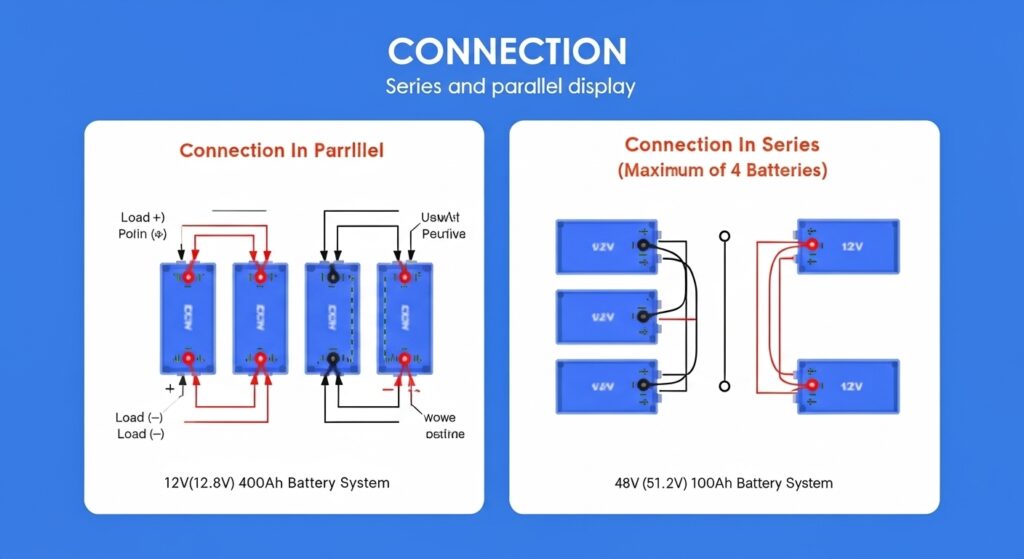
Wiring batteries in series increases the system voltage while the amp-hour (Ah) capacity stays the same. Wiring batteries in parallel keeps the voltage the same but adds capacity (Ah); meaning more runtime.
In short:
- series = higher voltage
- parallel = more available current/capacity.
Quick example:
Two 12-Volt 120-Ah (capacity) batteries in series → 24 V, 120 Ah → energy = 24 × 120 = 2,880 Wh.
Same two batteries in parallel → 12 V, 240 Ah → energy = 12 × 240 = 2,880 Wh.
Hence, you get the same total energy either way — you’re changing voltage vs capacity, not creating extra energy.)
Important Note: Always use identical batteries (same chemistry, voltage and Ah) when connecting batteries in series or parallel. Mixing different sizes, ages or chemistries can cause imbalance, damage or safety risks.
Explore the detailed breakdown below for wiring steps, pros/cons, safety tips and recommendations.
Batteries in Series
Wiring batteries in series increases the system voltage but does not change its amp-hour rating. To connect in series, link the positive terminal of one battery to the negative terminal of the next, chaining all batteries in a line. The free positive terminal on one end and free negative on the other become the bank’s output.
For example, two 12 V batteries in series yield a 24 V, 100 Ah bank. Three 12 V in series make 36 V at the same 100 Ah.
Think of it as making one higher-voltage battery. This is used when your loads (like inverters or motors) need higher voltage.
How to Wire Batteries in Series: Step-by-Step Guide
Follow these steps to create a series battery bank:
- Link battery terminals: Use a heavy gauge jumper cable to connect the positive terminal of the first battery to the negative terminal of the second battery.
- Continue linking: Repeat until all batteries are chained in series. Each battery’s positive goes to the next battery’s negative.
- Connect to load/charger: Attach the positive lead of your inverter or charger to the free positive terminal on the first battery in the chain. Attach the negative lead to the free negative terminal on the last
Safety Tips for Wiring Batteries in Series
- Use identical batteries: Match voltage, capacity, chemistry, and age to prevent imbalance or damage.
- Use correct tools and cables: Wear safety gear and use cables rated for the higher series voltage and current.
- Check polarity twice: Always connect positive to negative as intended — reversed polarity can cause sparks or damage.
- Include a Battery Management System (BMS): A BMS balances cells and protects against over-voltage or deep discharge. (Topo DC’s Centerfire systems include built-in BMS for safety.)
- Fuse or circuit-breaker protection: Install a fuse or breaker on the positive line to guard against short circuits.
- Use the right charger: Always charge with a charger rated for the total system voltage.
Pros and Cons of Series Battery Connection
Pros:
- Increases system voltage for high-power setups
- Reduces current draw for the same power output
- Allows use of thinner cables and reduces voltage drop
- Improves efficiency over long cable runs
- Enables charge controllers to handle more power
Cons:
- All connected devices must handle higher voltage
- 12 V appliances can’t run directly without a DC–DC converter
- One battery failure disables the entire series bank
How Many Batteries Can You Use in Series?
There is no strict electrical limit to series count, but manufacturers mostly set a practical limit; commonly up to four 12 V batteries for 48 V total. Exceeding recommended limits can void warranties or overstress the batteries.
How to Charge Batteries in Series Connection
Charging a series bank is straightforward:
Attach the charger’s positive lead to the free positive terminal on the first battery, and the charger’s negative lead to the free negative terminal on the last battery.
In other words, you charge across the entire series string exactly as if it were one higher-voltage battery. Always ensure the charger’s voltage matches the sum of the batteries. For example, a 24 V charger for two 12 V batteries in series, or 36 V charger for three 12 V batteries, etc.
Batteries in Parallel
Wiring batteries in parallel increases capacity (amp-hours) while keeping the voltage the same. In a parallel bank, all positive terminals are tied together and all negative terminals are tied together.
The bank’s output voltage is simply the same as one battery (e.g. 12 V) but the total amp-hours is the sum of all batteries.
For example, two 12 V 100 Ah batteries in parallel give a 12 V 200 Ah bank. Three such batteries would be 12 V 300 Ah. This effectively extends runtime for 12 V systems. Parallel banks still must use identical batteries (same voltage and capacity), otherwise one battery can become overworked.
How to Wire Batteries in Parallel: Step-by-Step Guide
To wire batteries in parallel:
- Connect all positives: Use heavy jumper cables or a bus bar to link the positive terminal of each battery to the positive terminal of the next (and so on).
- Connect all negatives: Likewise, tie every negative terminal together. You can use a single run of cable daisy-chaining through all negatives, or a common negative bus bar.
- Attach to system: Connect the free positive and free negative of the parallel bank to your load/charger. Because all like terminals are already common, you can attach your inverter or charger to any battery’s positive and any battery’s negative.
This forms a single 12 V system with much larger amp-hour capacity. Using a metal distribution block (like Topo DC’s MAG Series panel) can simplify these connections.
Safety Tips for Wiring Batteries in Parallel
- Use identical batteries: Match voltage, capacity, chemistry, and age to ensure even load sharing and longer lifespan.
- Use quality cables and connectors: Parallel setups carry high current. Use heavy-gauge, low-resistance cables and secure lugs.
- Fuse each battery: Install a fuse or DC circuit breaker on every battery’s positive lead to prevent a short from affecting the whole bank. Topo DC systems include magnetic breakers for built-in protection.
- Connect terminals correctly: Tie all positives together and all negatives together. For best balance, connect the load across different batteries to equalise charge and discharge.
- Use a BMS or battery balancer: Keeps lithium batteries balanced and prevents uneven voltage between units.
- Match voltages before connection: Ensure all batteries are at the same voltage before linking to avoid overcharge or discharge issues.
Pros and Cons of Parallel Battery Connection
Pros:
- Increases capacity (amp-hours) for longer runtime
- Keeps voltage the same; ideal for 12 V systems
- Provides redundancy; system keeps running if one battery fails
- Simple setup for extending power in vehicles, boats, or RVs
Cons:
- Higher current draw requires thicker cables and strong connections
- Greater risk of voltage drop and heat buildup
- Longer charging time due to larger total capacity
How Many Batteries Can You Use in Parallel?
Practically unlimited. You can add as many identical batteries in parallel as needed to reach your desired capacity. Each added battery adds more runtime.
Just remember, the more batteries you parallel, the longer it will take to fully charge the pack, and the more current the bank can supply. So robust cables and fuses become critical. Space and budget usually become the limiting factors, not any electrical limit.
How to Charge Batteries in Parallel Connection
Charging a parallel bank is similar to series wiring:
Simply attach the charger’s positive lead to one battery’s positive terminal and the charger’s negative to one battery’s negative terminal. Because all positives (and all negatives) are tied together, the entire bank charges evenly.
For best results, use the same gauge of cable to connect the charger to the bank as you would between the batteries, and ensure the charger is set for the bank’s voltage (e.g. a 12 V charger for a 12 V parallel bank).
Can You Wire Batteries in Series and Parallel at the Same Time?
Yes, you can combine series and parallel wiring to build large battery banks that increase both voltage and capacity.
In a series-parallel setup, you first create several series strings and then connect those strings in parallel. For example, you might make two 24 V strings (each with two 12 V batteries in series) and then tie the strings together in parallel. This yields a 24 V bank with double the capacity of one string. This approach is common in RVs, boats and solar systems where you need higher voltage but also more amp-hours.
How It Works:
In a series-parallel bank, each string acts like one battery. For instance, 4×12 V batteries in series gives one 48 V unit. Then you build an identical 48 V string and connect them in parallel. The result is 48 V at twice the capacity (like a 48 V, 2× amp-hour battery).
This scales up: you can have many strings in parallel to reach the desired total capacity.
Safety Tips for Series-Parallel Battery Systems
All the usual precautions apply, plus a few extras:
- Use identical batteries: Ensure every battery in the bank matches in voltage, capacity, chemistry, and age to prevent imbalance.
- Fuse each series string: Install a fuse on the positive end of every string before connecting them in parallel to isolate faults safely.
- Size cables correctly: Calculate total current from all parallel strings and use cabling rated for that combined load.
- Label all connections: Mark battery groups, cable ends, and fuses clearly to simplify maintenance and avoid wiring errors.
- Balance each string first: Confirm each series string has the same open-circuit voltage before paralleling to ensure equal performance.
- Use a reliable distribution board: A quality board safely manages multiple inputs and outputs in complex systems.
Quick Comparison: Series vs Parallel vs Series-Parallel Battery Connections
| Connection Type | Voltage | Capacity (Ah) | Best For | Main Benefit |
| Series | Increases | Same | High-power inverters, long cable runs | Higher efficiency |
| Parallel | Same | Increases | 12V accessories, longer runtime | More capacity |
| Series-Parallel | Increases | Increases | Off-grid, RV setups | Balance of both |
Batteries in Series vs. Parallel: Which is Right for Your 12V System?
Choosing series or parallel depends on your needs. If you need more voltage (e.g. to efficiently run a large inverter or reduce cable thickness), go series. If you need more capacity (longer run-time at 12 V), go parallel.
Many dual-battery systems like Australian-made Topo DC Long Range battery packs let you do either by including DC–DC converters and distribution boards that support both methods. For a typical 12 V vehicle or boat, a parallel setup is often simplest, it extends run-time without extra electronics. But for high-power setups, series (24 V, 36 V, etc.) can be more efficient.
Ultimately, neither is better than the other universally. It’s about which best meets your voltage and current requirements. If you need the benefits of both, a series-parallel configuration may be the answer.
FAQs About Series vs Parallel Batteries
- Which is safer: series or parallel battery connections?
Neither method is inherently safer. Both are equally safe if done correctly. The main risk with series is higher voltage. With parallel it’s higher current (shorts can be bigger). Follow safety steps like correct fuses & matching batteries and both are safe.
- Is it better to connect batteries in series or in parallel?
It depends on the application. Series connections add voltage, parallel add capacity. Neither is universally better than other. You choose based on whether you need higher voltage (series) or longer runtime at the same voltage (parallel).
- Can you put two 12 V batteries in series?
Yes. Two 12 V batteries wired in series form a 24 V bank. For example, two 100 Ah 12 V batteries in series give a 24 V, 100 Ah battery. Just ensure your equipment (charger, inverter, etc.) can handle 24 V.
- When should you use parallel vs series batteries?
Use series if your loads or inverter perform better at higher voltage (to reduce current draw). Use parallel if you want to run 12 V devices longer (more amp-hours). For instance, most 12 V fridges and lights can be run longer with two batteries in parallel at 12 V, while a high-power inverter might favour a 24 V series bank.
- Do batteries last longer in series or in parallel?
Batteries last longer in a parallel setup, because the voltage is the same but the capacity increases. For example, two 12 V 50 Ah in parallel make 12 V 100 Ah, so they’ll power a load roughly twice as long. In series, the capacity stays the same so runtime doesn’t improve.
- Can you put LiFePO₄ batteries in series?
Many LiFePO₄ (lithium iron phosphate) batteries can be wired in series, but only if the batteries are designed for it. Some LiFePO₄ units cannot be series-connected without damage. Check the manufacturer’s specs or manual.
- Can you wire different batteries in parallel?
No. You should never wire batteries of different voltage or capacity in parallel. Always use identical batteries (same voltage and Ah rating) in any parallel bank. Mixing batteries in parallel can cause very uneven charge/discharge and can damage the batteries.
Feeling frustrated by dead batteries on your Perth trips — unsure whether to wire series or parallel?
Get the Right 12V Dual battery System Setup at Topo DC Power
Stop guessing and start enjoying reliable power. Whether you need more voltage for a high-power inverter or more runtime for fridges and lights, Topo’s Australian-made systems solve the confusion around 12V batteries in series vs parallel.
We’ll recommend the best configuration for your rig, fit a tidy battery box dual battery solution, and show how our Centerfire and Long Range packs, paired with MAG Series distribution, make wiring, charging and protection simple and safe for WA conditions.
Ready to upgrade your power setup?
Contact us today to get an expert system that handles series and parallel wiring seamlessly.
Explore Topo DC Power Systems Today